Double Barley Yield with Clay Spreading and Mixing
Article provided by DPIRD (SWAN Program Team)

Deep pale sandy soils with compaction, poor water and nutrient retention are widespread across medium to high rainfall zones of southern Western Australia. These soil constraints limit root growth, water-holding capacity, and nutrient use efficiency. While single action soil amelioration such as deep ripping, mouldboard ploughing, and rotary spading can address specific constraints, they often do not resolve the multiple constrictions that occur in the soil profile.
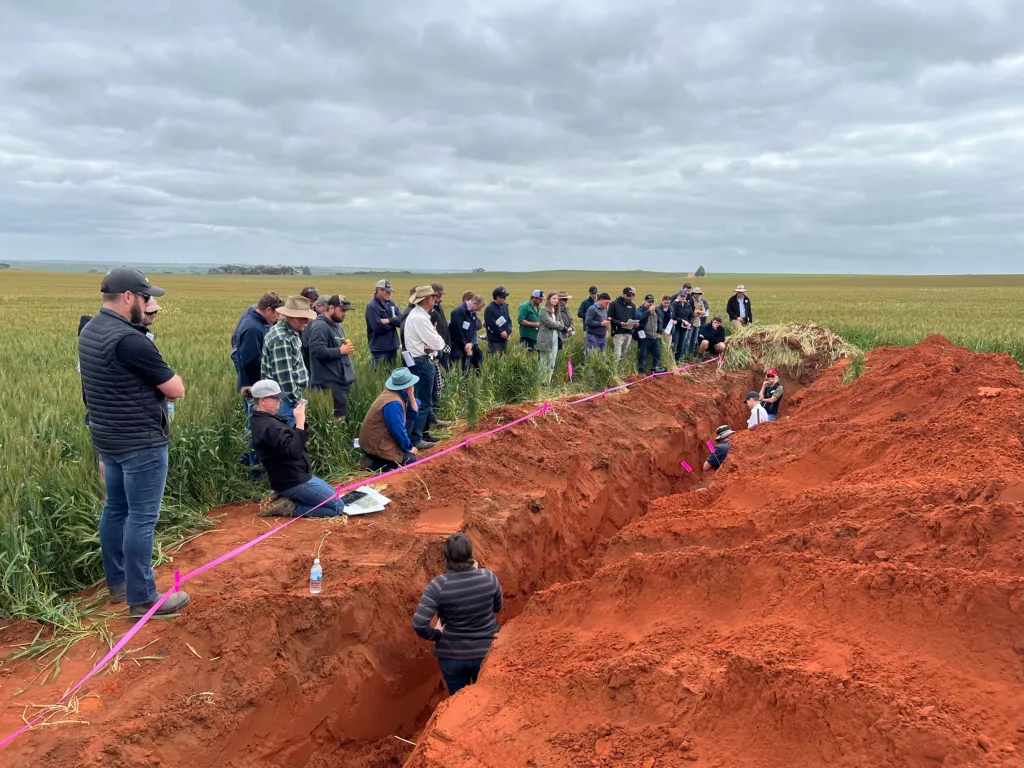
To address these challenges, a field trial was established at Badgingarra in 2025 under the Soil Water and Nutrient (SWAN) program to investigate innovative soil profile re-engineering approaches for deep pale sandy soils. Unlike single soil amendments, re-engineering addresses multiple soil constraints deeper in the soil profile, creating better conditions for root development, greater access to stored soil water and nutrients, and enhanced water use efficiency.
SWAN
The Soil Water and Nutrient (SWAN) Program is a five-year strategic collaboration between Grains Research and Development Corporation (GRDC) and the Department of Primary Industries and Regional Development (DPIRD) that started mid-2024. The designed outcome of the program is increased water and nutrient use efficiencies in Western Australian broadacre crops.
The SWAN strategic collaboration consists of three integrated research programs:
Program 1 – Soil Re-engineering and Water use efficiency
Aims to improve the access of crop root systems to water and nutrient stored in sub-soil by removing soil constraints to a depth of 80 centimetres, leading to substantial gains in crop productivity and profitability.
Program 2 – Nutrient Use Efficiency
Aims to identify cost-effective nutrient management strategies to improve productivity and fertilizer use efficiency.
Program 3 – Adoption and Industries Impact.
Aims to provide industry with access to consolidate knowledge on both program one and program two by developing an online hub for diagnostic decision-support tools along with strategic communications to maximise the impact and adoption of SWAN research outcomes.
The Trial
Within SWAN program 1, the Badgingarra trial is evaluating soil profile re-engineering techniques to overcome multiple soil constraints. Located just north of Badgingarra on Kenny’s property Winjardi Downs, the experiment is investigating the incorporation of clay at two application rates (450 and 900t/ha per 40cm depth) and three incorporation depths (40,80 and 120 cm).
The experiment aims to improve soil water-holding capacity, reduce nutrient leaching, and increase water use efficiency of grain crops with the addition of clay.

Barley Performance in 2025
| Treatment | Grain Yield (t/ha) | WUE (kg/mm) |
| Control | 1.43 | 10.6 |
| NC-S40 | 1.94 | 14.4 |
| LC-S40 | 2.81 | 20.8 |
| LC-80 | 2.66 | 19.7 |
| LC-120 | 2.71 | 20.1 |
| HC-S40 | 2.96 | 21.9 |
| HC-S80 | 2.86 | 21.2 |
| HC-S120 | 3.13 | 23.2 |
Notes: NC = No Clay, LC = Low Clay (450t/ha/40-cm), HC = High Clay (900t/ha/40-cm), S = Spading (Depth in cm)
Barley showed a positive response to soil re-engineering, demonstrating the potential of this approach to improve crop performance on deep pale sandy soils.
Results from the first barley harvest in 2025 showed that all treatments increased grain yield compared with the control. Grain yield nearly doubled under LC-S40 treatment, increasing from 1.43 to 2.81 t/ha.
Badgingarra trial is continuing in 2026, with researchers monitoring crop performance throughout the growing season. With favourable seasonal conditions and the promising outcomes from last year, the team is looking forward to another successful harvest and gaining further insights into the long-term benefits of soil re-engineering for growers. Within the project timeframe it is anticipated this trial will help shape economical feasible recommendations for improvement of deep pale sands.
Related links
https://soilswest.org.au/soil-water-and-nutrition-collaboration